

Posting old things while I write new things. This review of Lili Anolik’s Hollywood’s Eve was published in The Australian in 2019. There has been so much Eve since, so much posthumous piecing together of personality. Babitz as verb: to gorge on life (just as long as you are gorgeous).
“I did not become famous but I became close enough to smell the stench of success. It smelt like burnt cloth and rancid gardenias …
- Eve Babitz - Slow Days, Fast Company
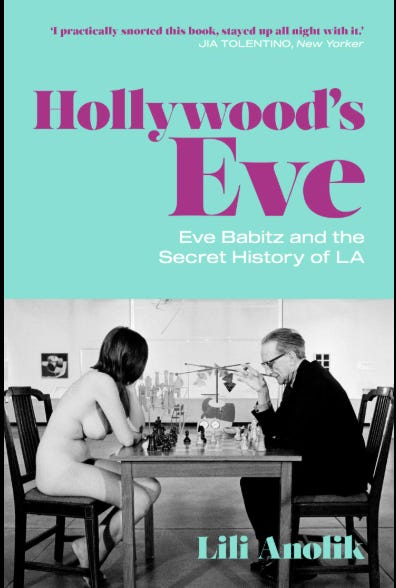
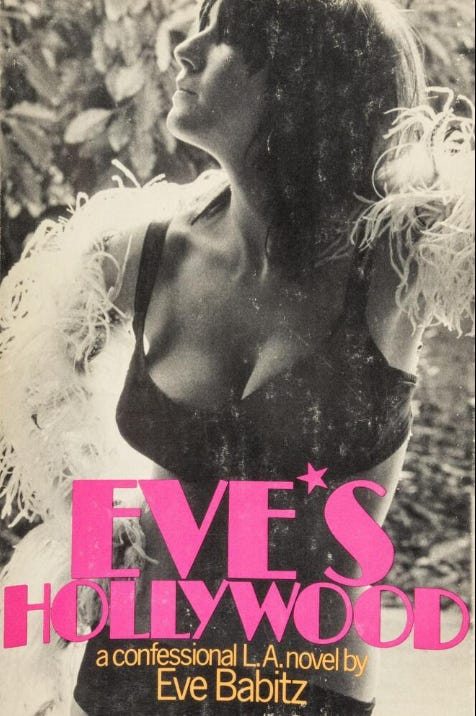
In the famous photograph Eve Babitz is naked, playing chess with fully-clothed Marcel Duchamp. She is in profile with her hair hanging over her face - showing herself, but not showing herself. Eve later reported that Duchamp checkmated her, but she still felt like she’d won because she’d managed to ruffle her boyfriend Walter Hopps’ feathers, which had been her aim all along. Babitz wasn’t thinking about immortality. 1965 was all moment. Eve Babitz is having another moment right now, lauded as a literary icon/artist/It girl/‘adventuress’ chronicler of decadent L.A. Her confessional novels, Eve’s Hollywood, Slow Days, Fast Company, Sex & Rage and L.A. Woman, are back in print, soon to be a TV series. Lili Anolik’s biography ‘Hollywood’s Eve - Eve Babitz and the Secret History of L.A.’ has come out at just the right time, although it was years in the making. From the first Anolik warns us that ‘Hollywood’s Eve’ isn’t a traditional biography: It is “above all else: a love story. The lover, me. The love object, Eve Babitz, the louche, wayward, headlong, hidden genius of Los Angeles.” It’s also about projection and illusion - in other words, it’s a very L.A. story.
Pop Culture loves a resurrection, and Babitz has teetered on the brink of breaking through for years. She is the messy, mouthy yang to Joan Didion’s coolly detached yin, Forrest Gump-ian in her ability to be in on any number of vital end-of-the-century scenes. Her father was a violinist at the studios, her mother was an artist. Stravinsky was her Godfather; Edward James and Aldous Huxley were among the frequent houseguests. How could Eve Babitz have not been precocious? She started writing her memoirs at 14 and, as she writes in Eve’s Hollywood, “I never really stopped.”
Lili Anolik pursued Babitz via her inner circle - sister Mirandi, cousin Laurie, ex-lover Paul Ruscha (brother of Ed) - before finally securing a lunch, where Babitz left as soon as she’d cleared her plate. Much mention is made of Babitz’s appetites - there is something sniffy and ungracious in the way some male sources describe her, almost as if she she was too much for them. Eve the Conquerer and non-conformer, seems a woman before her time. When she realised writing was going to be her great love, she said: “Normal men aren’t going to love anyone who looks forward to anything but them. And I couldn’t help looking forward to being published.”
When Anolik finally met Eve Babitz, she writes, “we couldn’t get any rhythm flowing. I was uptight and overeager. And she, no doubt, was bewildered: Who was I exactly and what did I want from her?” Anolik asks herself this too: ”Is the fascination she exerts over me simply that of The Other? … Or am I fulfilling a desire still more illicit, profound and secret, so secret in fact that it’s unknown even to me?”
In 1997, Babitz accidentally set herself on fire (she dropped a cigar while driving), acquiring third degree burns. “I’m a mermaid now, half my body.” Anolik admits to being both attracted to and repulsed by Babitz, the idea ”that Eve, famous for her beauty and seductiveness was now a ruin and a gorgon.”
Reading ‘Hollywood’s Eve’ is like a long, hazy night, or the surreal capsule episode of your new favourite series. It made me feel dizzy, a bit hungover. In the final section, Anolik shifts focus to Eve’s younger sister, Mirandi, who was immersed in the same scenes (Eve slept with Jim Morrison, but Mirandi made his famous leather pants.) Mirandi is candid about the darker aspects of growing up in a world of “the arts” and all those famous houseguests: child abuse and botched abortions and celebrity menages and psychic damage. Stories swirl, but the real Eve resists unmasking. And while the non-linear structure saves the reader from viewing Babitz’s story as a tragedy, it made this reader feel a bit like I was swimming around with no sign of the shore. All the more reason, then, to go back to the original books, to find the life and spirit of place in Babitz’s storis as she tells them: “The gates to my past aren’t rusty. creaking, laced with fog. They’re the unceremonious whoosh that the sound of the rear door of a bus made as down I stepped, impatient to drown in the hot, open days of my 14th summer.”
Hollywood’s Eve - Lili Anolik, Simon & Schuster, 2019
I loved this (I love all things Eve Babitz) I've yet to read Hollywood's Eve or Didion and Babitz. great review!