
Visual Diary #29
Dandelion Clock, Black Dog, Worst Person in the World, Cocktails

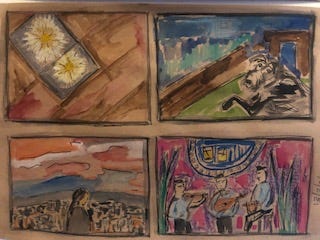
Hi friends,
I had the lurgy this week. The lurking lurgy. It’s meant that the Labour Day break did not feel very break-y and the long list of things I had to do is not done. But I did manage to get some gold dust in there, not least a little gather, buying myself flowers a la Miley, dandelion tea, and movies! including The Bride (it’s getting all the negative press, but I have to say I enjoyed its janky Rocky Horror meets Bugsy Malone meets that-moment-in-Times-Square-when-all-the-teenage-girls-black-out-their-eyes-and-wear-garbage-bags-and-take-back-the-streets, and I am a sucker for monster pathos. Have you seen? What did you think?
My Wander-y project with Lisa D’Onofrio Map of Lost Places is now open for submissions - please share with your writerly circles! Our aim is to collect new stories about lost places. We used to do a lot of these mapping & writing projects and then we had a break for, oh, about a decade - it feels exciting to be doing this kind of work again. Meanwhile I have been reading a couple of books about topophilia: Places Women Make by Jane Jose (Wakefield Press 2016): “Cities are the playrooms of our lives, holding our pasts and promising our future ...” and Pioneers of Modernism by Harriet Edquist: “For England, Briggs reserved the term ‘bungalow’ for a little country house, a homey, cosy little place, with verandas and balconies, and the plan so arranged as to ensure complete comfort, with a feeling of rusticity and ease.”
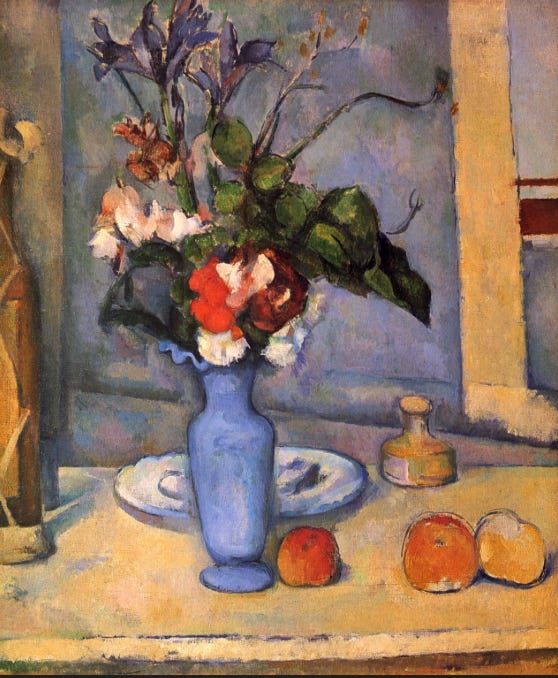
This morning I went to Bundoora market where I ate crepes and listened to a woman singing olde folk songs unaccompanied. I bought some herbs to plant, some Andy Warhol playing cards and a print of Cezanne’s le vase bleu (1887):
Then on the way home I found two mid-century hairpin leg hoop plant stands on hard rubbish. Also, all week I’ve been yearning for a little house in the country, but as soon as I was on my bike riding around it felt perfectly fine to live where I live.
I hope you too have had some gold dust amid the hurlyburly and hard stuff (because there is always hard stuff).
Anyway, here’s the week’s pictures:
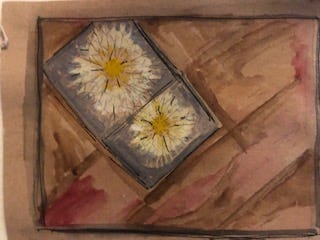
This is one of my treasures - a paperweight of a dandelion clock in lucite. This week I had even more vivid dreams than usual; in one I picked up the cube only to find it disintegrating in my fingers. The line in my head when I woke up was, It can’t be saved. I haven’t really tried too hard to interpret this one, but the feeling was one of huge sadness. I bought the object in a tiny op-shop attached to a church in Swanley, Kent, which was, for 20 years, my faraway second home. The maker’s stamp, nearly worn off says SARAMADE - it was made by Sarah Rogers of Balscote - and I’ve just looked her up and can see a few of her paperweights on Etsy. It’s a comfort to know that if the dream comes true I can always get something similar. Then again, the original object’s value was in the finding, and my associations with place, and the feeling I get whenever I look at it, so even if it was the same, it wouldn’t be the same.
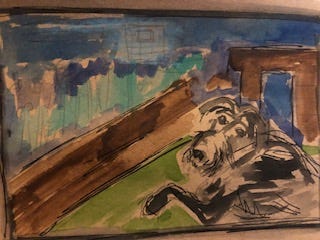
This is Scully sitting on the squeaky swinging chair in the morning sun.
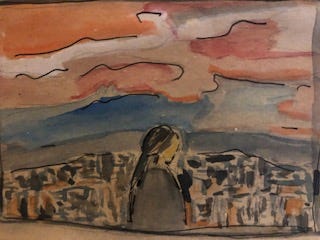
This is Julie in The Worst Person in the World (Joachim Trier 2021) which I watched (with tissues) in the middle of the day. (I always remember a girl I went to uni with sayiing that watching movies in the middle of the day was true decadence). I loved the film’s spacious structure - 12 chapters with a prologue and epilogue - and the way it felt both fresh and oft-told. Renate Reinsve says so much with a look - those scenes of her walking through Oslo - it felt like every time she looked across the city she was thinking of everything else in the world, all the lives you never have. In a 1986 paper Hazel Markus and Paula Nurius wrote that to dream of “possible selves” was to create "blueprints for change and growth”, but that it could also go the other way … In The Worst Person in the World Julie is unable to settle, unable to sit with herself, maybe. The story time is four years - she turns 30 in the middle - her behaviour is never explained or judged, we don’t know her motivations. It all reminded me of a feeling that dogged me as a young person, into my twenties - ‘Is that all there is?’ (which works as a life philosophy, I think). There’s generational talk throughout the film that I found really interesting, in particular the scene where Aksel, Julie’s older partner talks about nostalgia: “I grew up in a time when culture was passed along through objects. They were interesting because we could live among them”. The ending went a completely different way to what I was expecting, and, now I’m writing about it, I think I loved this movie. It also made me feel a bit better about my boxes of DVDs in the shed, my secondhand everything, my lack of trappings.
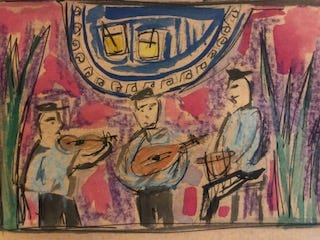
Lastly, this picture is of the charming Greek cafe I went to where there was endless music, Franco Cozzo decor, gorgeous young people, big bamboo, ashtrays on the laminex tables, deep-fried cheese and cocktails. I had a Mastic Sour and it was delish. Mastiha Liquer, which I have never before tasted in all my years, comes from pine tree resin. I felt like I was in Shirley Valentine (sans Tom Conti).
Mastiha Sour Recipe:
60ml (2 oz) Mastiha Liqueur (e.g., Skinos)
30ml (1 oz) Fresh Lemon Juice
10-15ml (0.5 oz) Simple Syrup or Maple Syrup (adjust to taste)
Optional: 1 Egg White (for foam) (this place used Aquafaba, which is not only a great word, but also a wild concept)
Garnish: Lemon/Orange twist or bitters
Method: Shake all ingredients with ice, strain into an ice-filled glass