
Visual Diary #30
Post-dog days, bougainvillea, dreaming of leaves and Tidmarsh Mill

Hi readers,
I hope you are well on this Monday morning. One of the legs snapped off my reading glasses last night. Also, I did I strength class at the gym last week and have only just stopped walking like Frankenstein. Such a sunny weekend - the last gasp of summer - the post-post-dog days. Usually this time of year I start scouting around for winter boots. I don’t buy them, I just scout around. I also look at parkas - particularly long mod parkas with furry collars, the kind that tall, rail-thin boys with dark shaggy hair and spotty complexions look good in. Last week was busy because I had a deadline (I don’t like them, but at the same time, it’s often the only way anything gets written - not counting this newsletter which is a subversive joy.) Now that’s done I can read again, and so I have about seven books on rotation. In recent weeks I looked at a couple of houses for sale; it was a lucky thing I was just looking because both went for $150000 + more than the ‘valuation’, and not even at auction. The world is crazy. A cabin in the woods or a cosy country cottage never looked so good (except for the petrol). Meanwhile, the landlord came over to check on all the broken things, and acknowledge that they are still broken. My silverbeet is raging. Little birds are singing in the sweaty pines. On my walk today I saw seventeen skinks.
Here’s this week’s pictures:
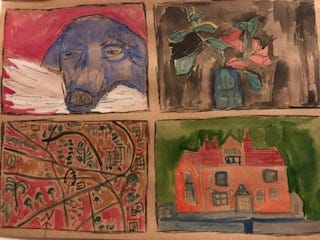
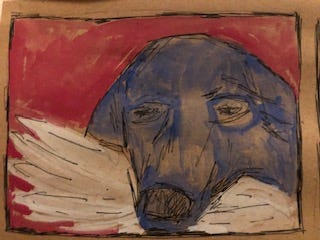
This is my rendition of the cover of Julip by Jim Harrison, a collection of three novellas, of which I only ever seem to be able to read the first (Julip). The book has one of my favourite epitaphs: “When the wine is bitter become the wine - Rilke”. It’s about Julip (named for the drink and the flower), a dog-trainer, who must track down her three ex-lovers (“The Boys” to get them to agree to a statement that will allow her brother (who shot them) to be trialled as mentally unwell. That’s it, that’s the story, but, being Jim Harrison, it feels mythic, dealing in ancient family tragedy, skewed humanity, but also full of funny lines, vivid pictures of wild animals, and dark hope.
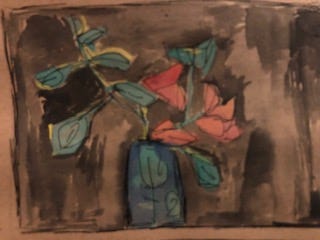
This is some bougainvillea in my Mum’s blue vase.
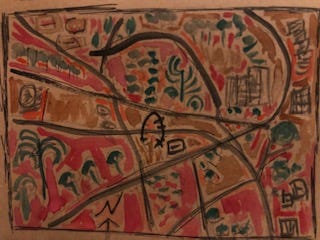
This is a section of a map of Putney Common, adapted from Jilly Cooper’s The Common Years, her diary of a decade of walking her errant dogs every day around the same expanse of green. It’s part nature diary, part social expose by a lady of means, but creative (read: eccentric.) I am finding it oddly mesmerising.
Thursday, November 6th
Grass full of rockets and squibs after Guy Fawkes Day. Leaves damp and brilliantly coloured after rain. Everything dripping. On the south side of Barnes Graveyard, the poplar which is surrounded by small squat oak trees, as lost all its leaves. It shivers in the icy wind like a stripper dancing orgiastically for a group of stolid Northern businessmen. Notice that sycamore and oak leaves turn grey when they fall, polar leaves turn black, elm leaves turn from yellow to mahogany. The fallen sycamore leaves, however, are brightened by cherry-red stalks. Leaves are caught up in the gorse bushes, the holly, the nettle beds, and in the wire fence around the tennis courts. At this time of year, says our gardener, he dreams of leaves.
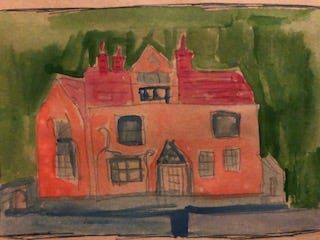
And we’re still in England. This is a sketch of a sketch of Tidmarsh Mill, where the painter Dora Carrington lived with Lytton Strachey and Ralph Partridge around 1917-18. I must try and find the biopic again. I have a memory of Carrington painting murals in all the rooms. This is from one of her letters: “The house is very old with gables and some lattice windows. It is joining on to the mill. A charming miller showed me over it. Very well built in good condition … More apple trees fruit trees vegetables. 2 miles from Theale St. 1 mile Pangbourne … Oliver etc must go and see Tidmarsh on Tuesday. Electric light in every room. I’m wildly excited. Hooray!” (from Carrington by Gretchen Holbrook Gerzine) …
I really hope some of your home's broken things get fixed, and not in a delicate kintsugi way, but properly, as befits a landlord's obligations to a fully-livable home. That you keep making and engaging with vibrant art despite the unworking bits (& gym-sore bits) is a quiet triumph.