
Visual Diary #38
Places you can't return to and places you can't leave

Hello,
How goes? Hope you are enjoying these bright and cold days. Hope you managed to get your tickets to MIFF if you’re in old Melbs and into that. I was hanging out to see The Shaggs documentary but it’s sold out, also, it was on really late, so I’ll just have to hope it gets a regular screening eventually. Once upon a time I was wooed with Who Are Parents on a mixtape. You can read Susan Orleon’s great piece on The Shaggs here. For a long time a feature film was slated, but I guess it’s been in turnaround forever. Sometimes docos can be a bit blow-smokey, but better than nothing I guess.
Semester 2 is all guns blazing with lots of good reading and class-planning, and diving back into old material and re-visioning and trying out different things. At night I go to bed with my brain buzzing and op-art flashes behind my eyelids. My dreams are more frenetic and technicolour than usual. Sometimes I imagine a life where all I do is read. And I wonder what it would it be like to not be always trying to write as well. But then I have a good writing day and can bask in the lovely having-written feeling. Living and writing. I don’t know why it has to be one or the other. Why can’t it be both?
Meanwhile, pictures:
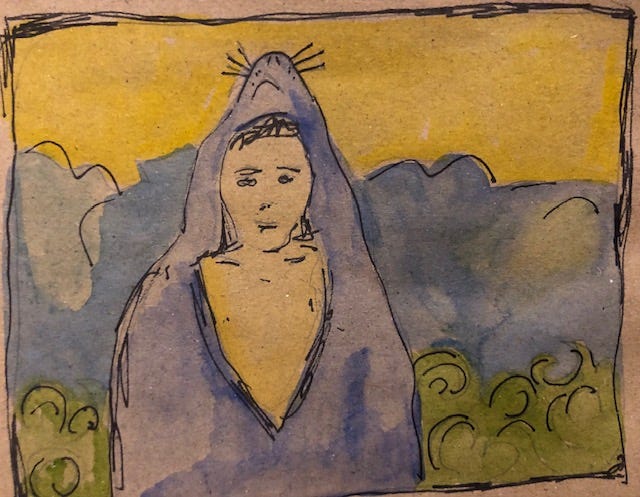
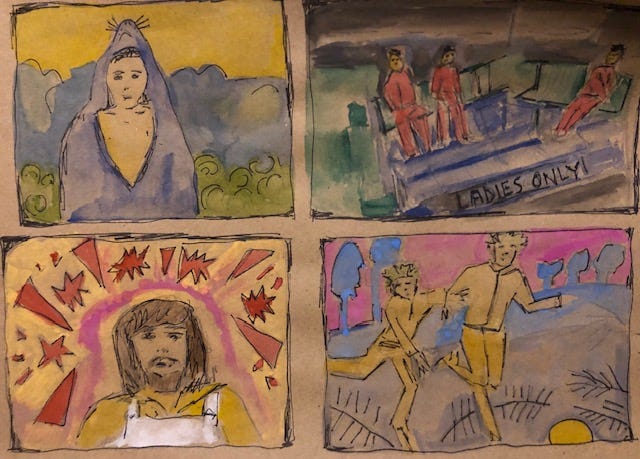
“He’s the King of all the selkies, he is; which means he’s the great bull seal that has his home deep, deep down in the deepest sea. That’s where the selkie’s own country is; and that’s where he rules, from a palace that has walls of crystal and floors of coral, with sea anenomes for jewels, and a roof of waving golden weed. Or maybe the roof is made of waving golden hair - the hair of drowned girls. Nobody knows for sure, for people can enter that country but that cannot come back again.”
This is the cover of A Stranger Came Ashore by Mollie Hunter. A novel from 1975 set in Shetland - ye olde Shetland, I’m pretty sure, because the family sleep in box-beds which, my research tells me, were phased out by the early twentieth century. The story follows 12-year-old Robbie Henderson and his family, whose lives change when they take in Finn Learson, washed up from a wreck after a fierce storm. On the very first night Robbie sees him doing some kind of mesmer-ing work with his dog, Tam. Robbie’s granddad Old Da tells him stories of the Otherworld, the trows and the Selkie Folk, and little by little Robbie begins to realise that Finn is the Great Selkie, come ashore to find a bride. He has his eyes on Robbie’s sister, and the whole village under his spell unless Robbie can fix things. This fairly ripped along, despite being tell-tale-y and ‘thin’ - I still found it suspenseful. I don’t think I read this as a child, though I might have. It certainly returned me to that age of falling into story and believing it all.
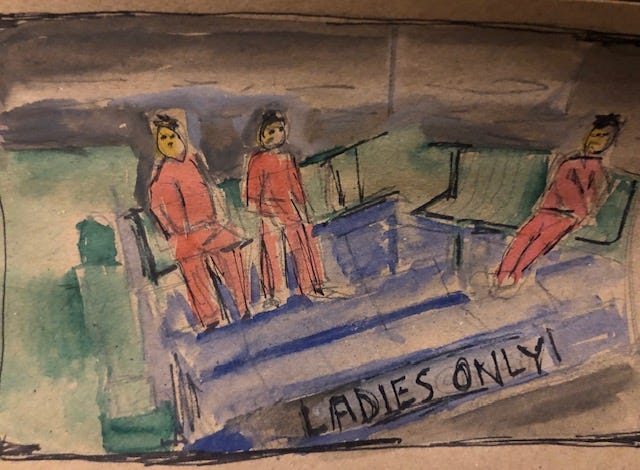
I caught up with Lisa D’Onofrio for a practice walk of the Map of Lost Places on a sunny Sunday. Every time we walk in the city we find new things and old stories, and beautiful buildings. This was where we ended up, at the Ladies Only bench where a bunch of young men in tracksuits sat with their phones and furtive looks. This, from the brilliant Robyn Annear’s new book ‘Corners of Melbourne’:
“Combining chivalry with utilitarianism’, the city council in 1934 ruled that some of the street seating alongside St Paul’s Cathedral would be ‘set apart for womenfolk’. These seats, facing busy Flinders Street station, had long been a popular spot for people-watching. The problem was that ‘men usurped more than a fair share of the accommodation’. So, the words Ladies Only were marked out in white tiles at the entrance to one of the seating alcoves. To no avail.
‘The summer,’ noted the Age, ‘brought the familiar sight of elderly women laden with parcels gazing wistfully at the seats, occupied by men.’ Thus the edict was amplified in painted letters 60 cm tall, and from time to time council workers would touch up the lettering – under the watchful eye of men seated there. In my teens I used to congregate with male friends on the Ladies Only seats, thinking we were sticking it to ‘the man’. How wrong can you be?”
Plus ça change, plus c'est la même chose.
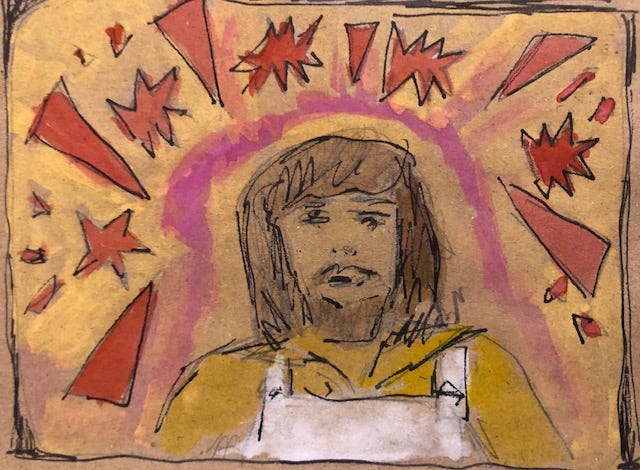
Speaking of childish things. I was sad to hear that my favourite Goodie Bill Oddie (Bloody Bill Oddie!) died. I loved all the Goodies deeply - Graham was so smart and Tim was so funny, but Bill Oddie was always my messy, loon-loving fave. I can’t really watch it now. But here’s the Funky Gibbon.
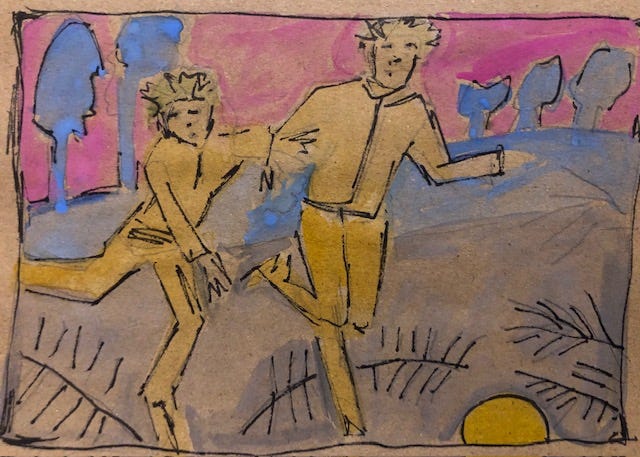
“Elidore spent a long time in that underground kingdom serving the prince. They used to go hunting together riding on little horses and following little greyhounds no bigger than terriers. But they never killed, for the people of that place ate neither fish nor meat .They were an honourable poeple who never made promises, because, they said, a man should keep his word without any bond, but they were kindly too.”
And this is a copy of an illustration by Emanuel Schongut of ‘Elidore and the Golden Ball’ - I am gearing up to read Alan Garner’s Elidor, but before that read Elidore in Dinah Starkey’s ‘Kings, Conjurers and Crocks of Gold’ (1975).
In the fairytale, Elidore, sick of wearing the dunce cap at school runs off to live in the woods, where he one day finds a magic cave, and is led by little men to a “gentle rolling country bathed in a curious silvery light”. He becomes the prince’s playmate, they play with a golden ball “all carved with flowers and running horses and it gleams”. On a visit home he tells his poor mother about the ball, and pesters him to bring it to her. He is torn, but eventually does as she asks, stealing it in the night and trying to abscond with it. He is chased by the little men, and trips and loses the ball. He tries to find the guards, following their footsteps, but when he gets to where the mouth of the cave was it is no longer there. “At last he gave up the search and made his way home again with a heavy heart to take up life as a mortal once more. For he was never to see the fairies again as long as he lived.”
One interpretation of this tale is that the golden ball represents childhood, and the closed up cave is that land you can never return to. And now I am collecting other ‘banished from eden’ type stories - Pied Piper is another one - can you think of any?