
Visual Diary #37
Fairy-folk, Meaningless Writing, Magic Snails and the River

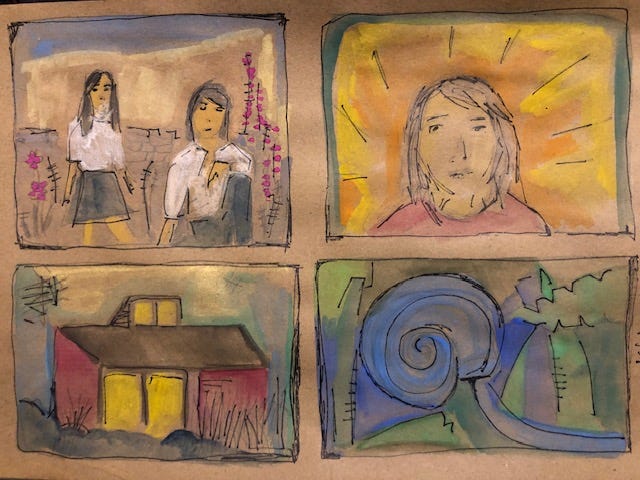
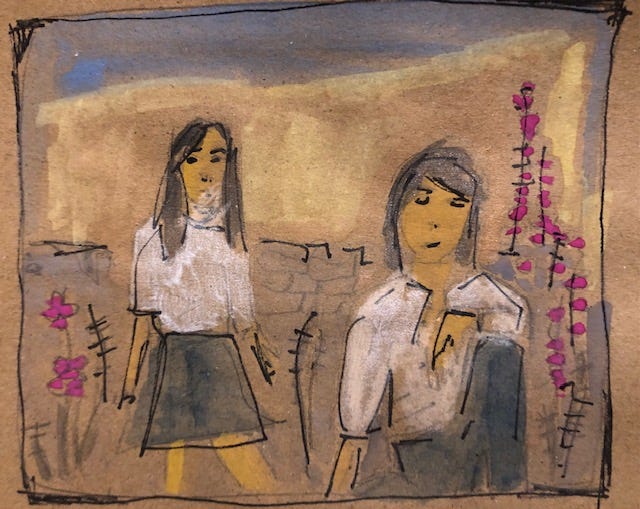
“The bomb site was wild. Just now, in the early summer, it wasn’t the jungle it became towards August and September, when the purplish pink flowers of the willow herb coloured the place as if it were perpetually in the glow of a sunset, and the long violet cones of buddleia filled the air with the smell of warm honey, which mixed oddly with the familiar London smell of hot soot, petrol fumes and tar.”
“What you’ve seen’s the stock, child. Didn’t your Mam have told you any tales of the good people? She’s from the city then, and trusting in stones and walls to keep them away …”
Lately my Saturday project is to read an old paperback children’s book with elements of folk or myth or the eerie about it. This picture is the cover of Thursday by Catherine Storr from 1974. Thursday goes missing, and it’s up to Bee to find him. They’re in love, but its tentative and not spoken about or public, the slow acknowledgement of what they mean to each other is something that drives the story. Thursday is different, ‘diffident’, and from a loveless home, he’s a talented guitar player, and at first it appears that he’s just left … but Bee feels that something’s wrong. Through conversations with Old Mrs Smith, who works at the local shop she comes to believe that he’s been taken by fairies -”They, them that’s everywhere, the good people.” Bee’s family are ordinary, working folk, not given to fanciful thinking, so much of the plot deals in Bee wrestling with belief, but maybe it’s all a metaphor for becoming an adult? Hmm. This feels contradictory - adult = giving up magical thinking, or is the idea that adult= world opening up and becoming narrower at the same time? Either way, it’s a grim picture of adulthood from a young person’s view. The story is padded out with life-stuff: slight rebellion, a fat best friend, a jolly pregnant sister-in-law, a bitter mother and absent father, a late performance of A Midsummer Night’s Dream, and some of-its-time othering. Bee and Thursday have a ‘place’ - a bombsite that’s been boarded over, where nature is finding is way back through the cracks. It is here where Thursday is taken, and where Bee must get him back to if she has any chance of saving him. In fairyland/the secondary world, time runs differently, what feels like a minute of feasting and music and flattery is weeks of waiting to those left behind.
Catherine Storr trained as a psychiatrist (but did not complete her training), worked as a psychotherapist and was married to psychiatrist, psychoanalyst and author Anthony Storr. Kimberley Reynolds writes: “Anticipating Bruno Bettelheim’s The Uses of Enchantment (1976), she argued that the many acts of cruelty and violence found in earlier children’s books as well as on television may help children acknowledge the dark and conflicted feelings we all harbour from infancy. ‘‘What we have to do,’’ she explained, ‘‘is to tell the children, ‘Yes, these feelings exist in us as well as in you and this is how in our society you should try to express them’’’ (p. 26). (‘‘I Write to Frighten Myself’’: Catherine Storr and the Development of Children’s Literature Studies in Britain Kimberley Reynolds, 2017)
A three minute digital exploration of Storr’s ‘Marianne Dreams’ can be seen here:
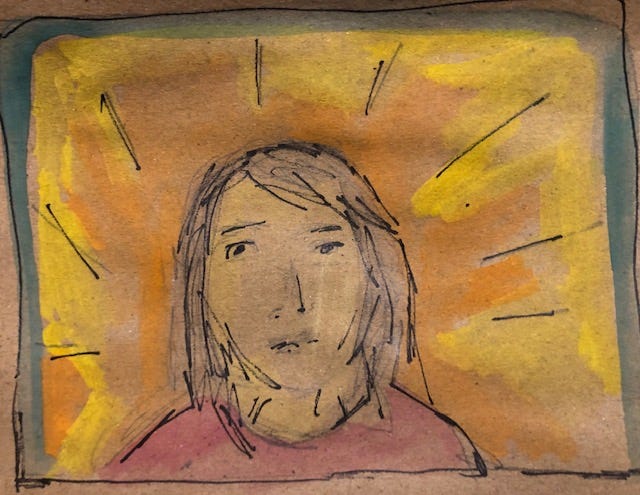
This is Annie Dillard (truly!) and this is from The Writing Life:
“Putting a book together is interesting and exhilarating. It is sufficiently difficult and complex and it engages all your intelligence. It is life at its most free. Your freedom as a writer is not freedom of expression in the sense of wild blurting; you may not let it rip. It is life at its most free, if you are fortunate enough to be able to try it, because you select your materials, invent your task, and pace yourself … The obverse of this freedom, of course, is that your work is so meaningless, so fully for yourself alone and so worthless to the world, that no one except you cares whether you do it well, or ever. You are free to make several thousand close judgement calls a day. Your freedom is a by-product of your days’ triviality …”
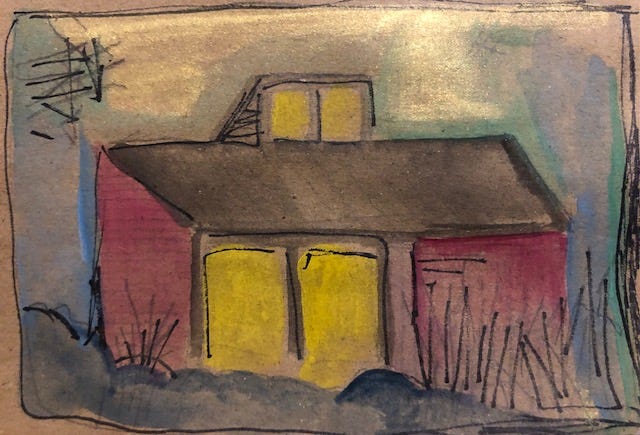
We’ve had such insistent and abundant sunshine this weekend. Yesterday I went on a very long walk around the river (listening to the audio of Elizabeth Strout’s The Things We Never Say) and admired the shapely houses of Alphington. This is one of them.
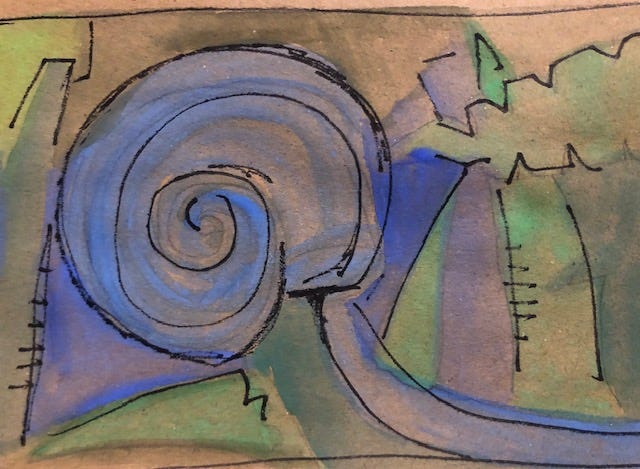
I went to see The Blue Trail (d/ Gabriel Mascaro 2025) with my Mum a couple of weeks back. The cinema was packed (for the Spanish Film Festival), and the film had come with some hype after winning a Silver Bear. 77-year-old Tereza, living in an alternate reality where the elderly are carted away to ‘the colony’ to be cared for whether they like it or not. Tereza, is very much in the ‘not’ camp. She manages to escape and through luck and persistence finds a way to live outside the system, connecting with shysters and renegades and undocumented people who live on and by the Amazon. A river movie, then, with all the symbolic associations a river can offer: life and time, journey and transition. What is freedom and who gets to be free? Would you squeeze “blue snail drool” into your eyes if it promised you ecstatic visions? The film was magic realist and dystopian, also: funny, provocative, dreamy, short, unresolved. “Thelma & Louise meets Soylent Green.”
“(We think) the young people are able to be rebels. The young people are fighting for politics change. We project a lot of elements and association of freedom and (rebellion) and passion for life to the young body, but to see that for the first time in this movie, it is so flourishing because it’s beautiful to be able to recognise freedom in a body with lots of wrinkles.”
From this good interview with Mascaro here
I have so many conversations with teachers these days who want to put on novels that are not "problematic" or "too sad" when young adult people need these novels to process grief.
Just fabulous